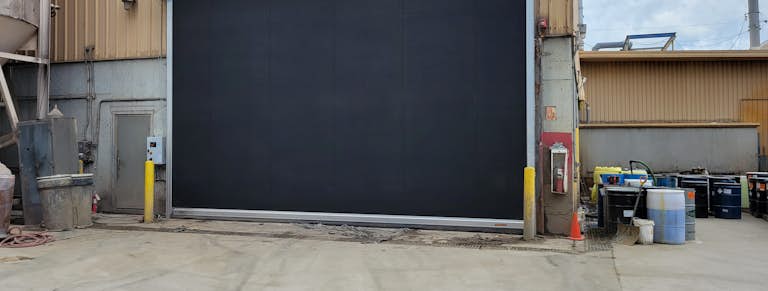
Top 5 Rubber Door Features that Make Them a Great Fit in Composting and Waste Management Environments
Topic Overview
Odors and emission control is a major concern for industrial composting facilities, which resulted in more operations moving into enclosed buildings over recent years. This is because composting biosolids release a high concentration of ammonia, a corrosive substance, into the atmosphere. Therefore, composting buildings must be constructed with materials that prevent corrosion, which is caused by high levels of gases and moisture emitted during the composting process. Building material options typically include concrete, fabric, pressure-treated lumber, pre-engineered steel, and stainless steel.1
In addition to the overall building materials, the doors selected for use on the building should operate fast to support odor and emission control and must also comply with corrosion-resistant specifications. Rubber doors check those boxes and have been a successful, low-maintenance solution in composting, recycling, and waste management environments for over twenty years.
Here, we will discuss the definition of a high-performance rubber door and briefly touch on its history. Next, we will cover the top five features that make rubber doors an excellent choice for challenging composting and waste management environments. Additionally, as a bonus, we will explain corrosion-resistant components based on environmental factors, and we will conclude with some information about the maintenance required for rubber doors (some of which may surprise you).
Let’s get started!
What is a High-Performance Rubber Door?
By definition, high-performance rubber doors are made-to-order, designed for higher durability, break away upon impact, and have self-repairing features that support minimal maintenance. They also include built-in and optional safety features along with a variety of activation methods, which make the doors safer for people, equipment, and products to pass through the opening and operate in the area.
Rubber doors were introduced in the late 1970s for use in mining operations, an industry that struggled to find a remedy for effectively closing extremely large mining openings while withstanding the concussion effect of nearby blasting and vehicle impact. Based on the successful solution that rubber doors provided to the mining industry, rubber doors began making their way into other extremely demanding applications including waste management. Today, these tough and reliable doors are a staple in waste management related facilities, which in recent years, expanded to industrial composting facilities because of the ability to incorporate corrosion resistant components into the already durable rubber door construction.
Sorry, there is no content available here.
Here are the top 5 features that contribute to why rubber doors are a great fit in waste management and composting environments:
1. Impactability
Remarkably, rubber doors are impactable, so if the door is accidentally hit, the bottom bar breaks out of the guide tracks. Facility maintenance staff can reset the door, which eliminates a service call. The ability for in-house staff to repair the door helps to reduce the likelihood of downtime since operations are delayed only as long as it takes to re-set the door, which can typically be done in just a few minutes. The ability to keep the door operational (and not stuck open) is mandatory to maintain the expected adherence to odor and emission control.
2. Tight Perimeter Seal
Sealing the spaces around the door is crucial for preventing odors and emissions from escaping the building. Because the rubber door panel fits snuggly into the guide tracks and the bottom edge seals directly to the floor for a tight perimeter seal, the door itself creates an effective barrier between the odors/emissions within the building interior and the neighboring communities on the other side. In contrast, traditional rigid metal doors rely on conventional, separate seals around the opening, which tend to deteriorate, resulting in gaps where air can infiltrate into the building. On a rubber door, the rubber curtain itself is the seal eliminating the issues seen with rigid metal doors.
3. Simple Design
Rubber doors have a simple design with very few moving components, which eliminates possible failure points, need for service calls, and ultimately reduces maintenance costs. There are no hinges, cables, drums, rollers, or sections that can trap waste and cause a mechanical failure or eventually wear out. Three panel materials are typical, and all are extremely tough and suitable for extreme industrial environments: SBR (styrene-butadiene rubber), EPDM (ethylene propylene diene monomer), and MSHA (Mine Safety and Health Administration approved). More about which panel material to use in general waste management or composting locations is below.
4. Built-In Safety Features
Safety of people around the opening and avoiding the door from closing on trucks are priorities. Modern safety features like our LED lite-advance signaling will help. The LED lite-advance signals when the door will open/close for an added level of awareness at the door opening. Also available is an upgrade from a standard panel reversing light curtain to photo eyes with a reversing edge, the combination of which automatically reverses and opens the door if it contacts an obstruction while closing.
5. Corrosion-Resistant Components
Corrosion-Resistant Components Based on Environment
Rubber Curtain
As mentioned previously, three heavy-duty rubber panel materials are available with Hörmann rubber doors, but all materials are not created equal when it comes to use in waste management environments or for corrosion-resistant compliance in composting locations. The SBR rubber panel is excellent for use in general waste management door openings where composting activities are not present. EPDM and MSHA panels are considered a good choice as well for that location. When it comes to door openings on composting facilities, since adherence to corrosion-resistant requirements is crucial, EPDM material is the only rubber material tested and proven successful for use in composting locations.
Door Components
Rubber doors are often equipped with standard equipment, such as aluminum guide tracks, aluminum bottom bar, as well as galvanized steel components like roll tube, guide guards, and mounting angles. When those finishes are not enough to satisfy corrosion resistant specifications, special finishes are available to meet that need.
Waste Management Environments: Door components with standard finishes like zinc dichromate and aluminum have a ‘good’ performance rating, while painted steel parts have an ‘excellent’ rating. In place of galvanized steel components, special finishes like stainless 304 and 316 are ‘excellent’ choices while epoxy finishes provide a ‘good’ level of performance. For the best performance, it is recommended to choose either painted steel or stainless-steel components for any door components that have those options available.
Composting Environments: Because corrosion resistance is a high priority in composting locations, door components should at the very least be made of aluminum. Aluminum parts have a ‘good’ corrosion resistance rating. However, epoxy painted components and those stainless 304 or 316 both have an ‘excellent’ corrosion resistance rating, so be sure to look for those components when pricing rubber door systems.
Operators and Control Boxes
Waste Management Environments: For general waste management areas, unless a specific substance is notable, the manufacturer’s standard direct-drive or chain drive operator along with their standard control box will typically meet the specification.
Composting Environments: Composting environments are a bit trickier. Direct-drive operators are not recommended because corrosion resistant protection is unavailable. Instead, look for chain drive operators that are available with OS3 surface protection or in 304 stainless steel, along with stainless steel hand chain, epoxy painted metal parts, stainless steel limit shaft, limit chain and drive chain. The control box may be either NEMA 4X fiberglass or NEMA 4X stainless steel depending on the specification.
Maintenance: What to Expect
Rubber doors are low-maintenance workhorses designed to operate seamlessly day in and day out. To keep your rubber door operating at its best, it should be inspected monthly to check things like light curtain integrity, drive chain tension, spring chain tension, and counterbalance springs. Based on specific conditions, chains and counterbalance springs may require lubrication. In addition, functionality of the reversing edge, photo eye, open/close limit settings, fasteners, and curtain tracking should also be checked monthly.
As needed, the rubber curtain may be cleaned with RV Rubber Roof Cleaner. There are no parts to replace during regular maintenance checks, but as the maintenance schedule approaches 100,000 cycles, replacement springs could be ordered to facilitate a scheduled change through your local door dealer. For doors with a higher number of annual cycles (>50,000), functional elements such as the operator and brake should be checking every six months.
There are a few wear items that depending on location and usage, could require replacement around the two-year mark. These may include chain drive operators, brake, reversing edge transmitter battery, seals/weatherstripping, and light curtain. For work on these components, it is best to call in your local door maintenance professionals for assistance.
Rubber Doors: A Successful Solution
With more composting operations moving into enclosed buildings, the need for corrosion resistant building solutions, including doors, is a necessity. As part of the solution, rubber doors operate fast to support odor and emission control, they comply with corrosion resistant parameters, and are a successful, low-maintenance fix for this demanding application.
Notes: BioCycle October 22, 2008 - Buildings and Corrosion Control